
Slotkin Pushes Bipartisan Effort to Block Chinese Connected Vehicles at Mackinac Policy Conference

Tony Carbone | May 28, 2026
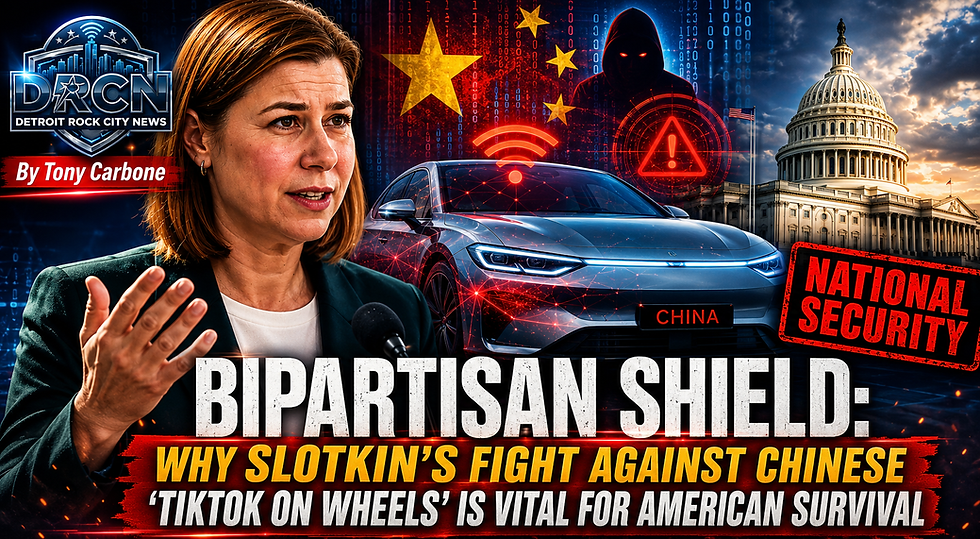
MACKINAC ISLAND, MI — U.S. Senator Elissa Slotkin used the stage at the 2026 Mackinac Policy Conference to call for stronger federal action against Chinese-manufactured connected vehicles, warning they could pose both economic and national security risks to the United States.
Speaking during the annual policy gathering on Mackinac Island, Slotkin argued that heavily subsidized Chinese automakers could threaten domestic manufacturing jobs while also introducing cybersecurity and surveillance concerns through advanced vehicle technologies.
“Our auto industry is foundational to the American middle class,” Slotkin said during the conference. “We cannot allow foreign adversaries to dominate connected vehicle infrastructure.”
Economic and Security Concerns
Slotkin pointed to the rapid international expansion of Chinese automakers such as BYD and Chery, which have gained market share in Europe with lower-cost electric vehicles backed by Chinese government subsidies.
Michigan officials and industry leaders have raised concerns that similar market penetration in the United States could place pressure on domestic manufacturers and suppliers, particularly in states heavily dependent on automotive employment.
Supporters of stricter regulations also argue that modern connected vehicles collect vast amounts of user data, including location tracking, camera footage, mapping information, and driving behavior analytics.
Slotkin compared the technology risks to social media surveillance concerns, describing Chinese-connected vehicles as “TikTok on wheels.”
Bipartisan Legislative Push
Slotkin has partnered with Senator Bernie Moreno (R-OH) on the proposed Connected Vehicle Security Act, legislation aimed at restricting Chinese-made connected vehicle hardware and software from entering the U.S. automotive supply chain.
The proposal comes amid broader concerns about trade loopholes and cross-border imports through Canada and Mexico. Slotkin and Representative Haley Stevens have also discussed additional measures targeting imported Chinese-nameplate vehicles entering through North American trade routes.
Potential Entry Points Under Review
Canadian border crossings
Mexican border crossings
U.S. ports and shipping terminals
Industry and Labor Reaction
Labor organizations and automotive executives have largely supported the proposed restrictions.
Teamsters General President Sean M. O’Brien said the union supports efforts to prevent foreign surveillance technologies from being integrated into U.S. transportation infrastructure.
Automakers including General Motors have also emphasized the importance of maintaining fair market competition while protecting domestic manufacturing capacity.
Conference attendees noted the bipartisan partnership between Slotkin and Moreno as a significant political development, particularly given the traditionally competitive relationship between Michigan and Ohio in the automotive sector.
Debate Over EV Transition
Some environmental advocates have expressed concern that limiting lower-cost Chinese electric vehicles could slow EV adoption in the United States. However, supporters of the legislation argue that national security and supply-chain protection should remain a priority as the country transitions toward electrification.
The debate reflects broader tensions between accelerating clean-energy goals and reducing reliance on foreign-controlled technology infrastructure.
— Tony Carbone
Opinion | No Apologies
Sources: michiganadvance.com, wlns.com, detroitnews.com, slotkin.senate.gov.


Comments