
Detroit’s Whiskey River

Frank A. Fiorello | Apr 20, 2026
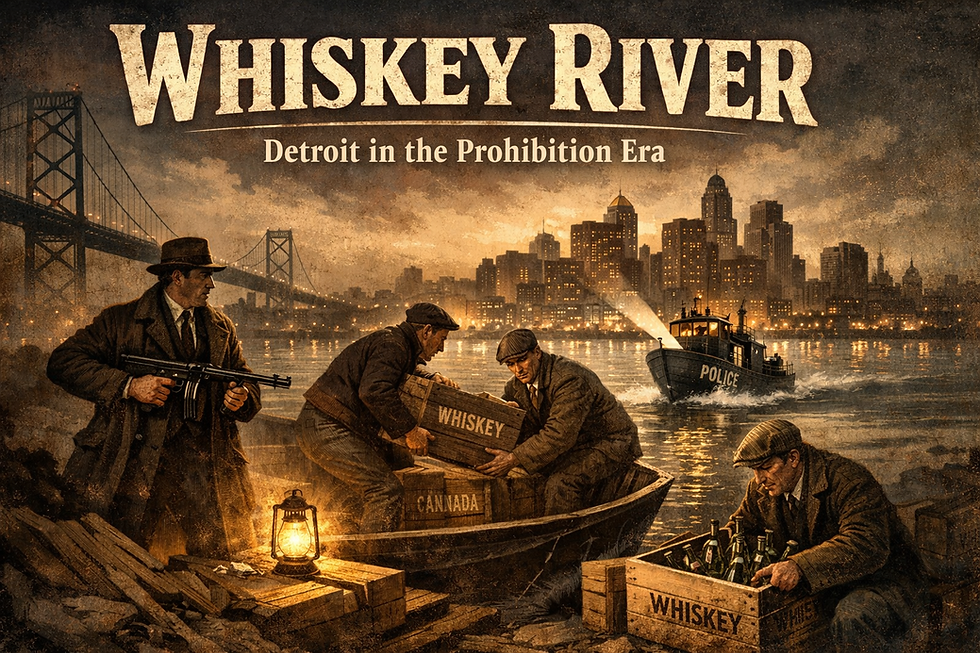
Imagine stepping back into the vibrant streets of Detroit in 1916, just four years shy of the Volstead Act, which would usher in the era of Prohibition. But here’s the twist: Prohibition was already beginning in Michigan! Picture this: the Detroit River, separating Detroit from Windsor, Canada, was affectionately dubbed the “Whiskey River.” And yes, Windsor is actually south of Detroit! Remember this when you hear Don’t Stop by Journey.
During this time, the Women’s Christian Temperance Union (WCTU) was gaining momentum, pushing for stricter laws against alcohol consumption. By 1916, Michigan had adopted the Damon Act, setting the stage for liquor prohibition starting in 1917—three whole years before the rest of the country joined in the dry crusade!
With many social movements they too had songs and battle cries like “A Temperance Battle Cry” and the lyrics went like this:
We are a band of temperance boys / Our drink is pure cold water / No whiskey and no rum for us / No beer, no ale, no porter / See the temperance wave advancing / O’er the Southern strand / Sweeping out the licensed evil / From a rum-cursed land / Chorus / Local option boats are launching / Counties far and nigh / And the good ship Prohibition / Will reach us by-and-by.
Fast forward to 1919, when the Damon Act met its match and was declared unconstitutional. But the saga didn’t end there! In 1920, the Eighteenth Amendment to the United States Constitution was adopted and later ratified by individual states, officially throwing the doors wide open to Prohibition.
Prohibition created a thriving black market for alcohol, as the demand remained high despite its illegal status. Entrepreneurs in Detroit saw this as a lucrative business opportunity and began smuggling alcohol from Canada into the United States.
The close proximity of Detroit to the Canadian border made it an ideal location for bootlegging operations. By capitalizing on the demand for alcohol, these early entrepreneurs were able to turn a profit during a time when many legal businesses were struggling to survive.
Cocktail parties became a popular social activity during Prohibition, especially among the social elites of Detroit. These parties provided a glamorous setting for individuals to indulge in illegal alcohol while socializing with friends and acquaintances. The sophistication of cocktail parties helped to normalize the consumption of bootlegged alcohol, contributing to its continued popularity throughout Prohibition.
While cocktail parties were a favorite pastime of the social elite, laborers in Detroit often enjoyed beer as part of their daily meals. Beer was considered a staple beverage for many working-class individuals, who would have a cold beer with their lunch and dinner. The accessibility of beer during Prohibition made it a preferred choice for those looking to relax and unwind after a long day of work.
The Detroit River, spanning 28 miles and narrowing to less than a mile at strategic points, provided a haven for smugglers with its hidden coves and secluded areas on its shores and islands. Teaming up with Lake Erie, Lake St. Clair, and the St. Clair River, this network of water routes, became the primary conduit for ferrying around 75 percent of the bootleg liquor into the United States during the Prohibition period.
The treacherous beauty of these interconnected waterways enabled smugglers to navigate discreetly, evading law enforcement and profiting from the illicit trade in alcohol, making Detroit’s Whiskey River a notorious hotspot for clandestine operations.
The Prohibition era opened up a world of celebrity rumrunners and gangsters. It allowed ordinary people to partake in illicit activities and profit from the demand for illegal alcohol. Gangs like the Purple Gang from Detroit and the foundations of La Cosa Nostra in New York took advantage of this environment to establish themselves as major players in the criminal underworld.
Detroit found itself grappling with a surge in criminal activity, complete with all the drama and excitement that comes when you outlaw something that people love. As cities along the Canadian border tightened their grips on booze, they inadvertently opened the floodgates for illicit enterprises.
According to the Detroit Historical Society, locals were quick to jump into the fray, competing fiercely for a slice of the burgeoning illegal liquor trade—Detroit style rum-running and booze peddling violence would make any gangster movie look tame!
As a result, speakeasies, affectionately dubbed “Blind Pigs,” popped up like mushrooms after a rainstorm. These secret bars became the talk of the town, with tens of thousands opening their doors for those daring enough to seek a bit of fun away from prying eyes. It was a wild time when jazz filled the air, and a simple password could lead you to an evening of revelry and mischief.
So, raise a glass (even if it’s just a pop for now) to the adventurous spirits of the past—Detroit’s rich history during Prohibition certainly wasn’t dull!
Frank A. Fiorello
Columnist | Detroit Rock City News


Comments