
Detroit’s Dirt, Power, and the Cost of Asking Questions

Frank A. Fiorello | May 21, 2026
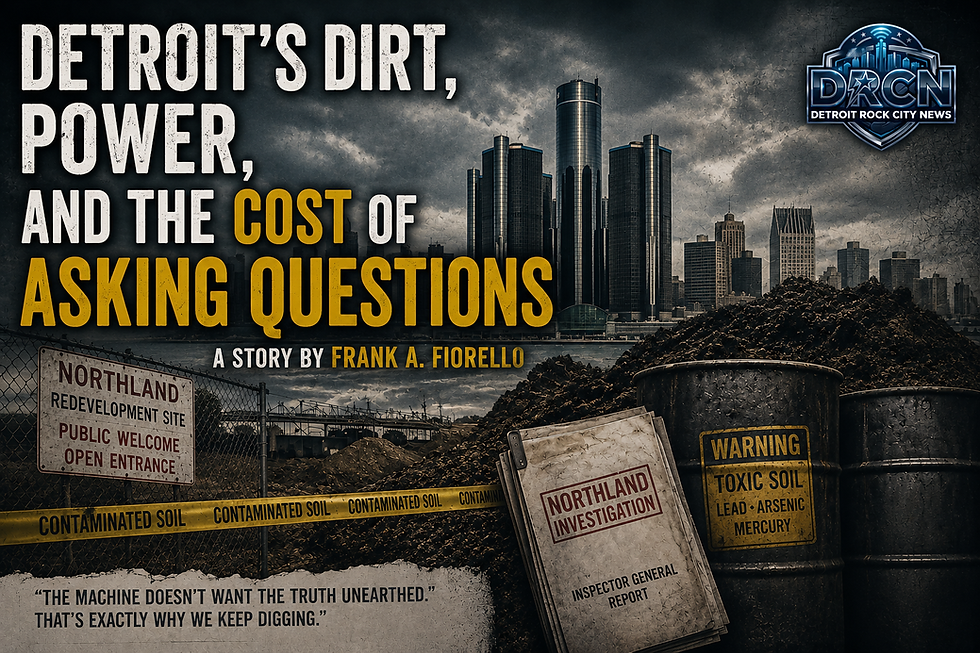
DETROIT, Michigan - In Detroit, the distance between an official press release and the truth can sometimes be measured in truckloads of dirt.
For years, city leaders have promoted the narrative of a revitalized Detroit—a city of ribbon cuttings, billion-dollar developments, luxury apartments, and national headlines celebrating its comeback story. Much of that progress is real. New investment has arrived, neighborhoods have seen renewed attention, and downtown development continues to reshape the skyline.
But beneath the polished image lies a persistent question that refuses to go away: Who is watching the people in power?
That question has become increasingly important as concerns over transparency, accountability, and public access to information continue to surface inside city government. Reporters, activists, and residents alike have frequently complained about delayed Freedom of Information Act requests, limited access to decision-makers, and what many describe as an increasingly managed public narrative.
The faces at City Hall may change, but many critics argue the culture remains the same.
With former Mayor Mike Duggan now focused on his campaign for governor, newly elected Mayor Mary Sheffield has inherited not only the city's successes but also its unresolved questions regarding government transparency and public accountability.
For journalists who continue digging into those questions, one name remains impossible to ignore: Charlie LeDuff.
For more than three decades, LeDuff has built a reputation as one of Michigan's most aggressive investigative reporters. His career has taken him from the pages of The New York Times to local television and independent media platforms. He was part of the Pulitzer Prize-winning reporting team recognized for national reporting in 2001 and later became known throughout Michigan for his relentless investigations into government waste, public corruption, failing infrastructure, and bureaucratic incompetence.
Whether exposing conditions inside Detroit's fire department, investigating pension controversies, or highlighting the struggles of working-class families often ignored by political elites, LeDuff built his reputation by going where officials preferred reporters not go.
Today, that reputation has placed him at the center of one of the area's most controversial environmental dispute.
The Northland Dirt Controversy
For months, LeDuff has focused significant attention on the former Northland Center redevelopment site in Southfield, where questions continue to surround the handling and disposal of contaminated soil generated during demolition and redevelopment activities.
Through reporting on the Michigan Enjoyer and the No BS News Hour, LeDuff has alleged that contaminated soil from the site may have been transported and used as fill material at demolition locations within Detroit neighborhoods.
The allegations gained credibility after findings from the Detroit Office of the Inspector General identified contamination concerns associated with fill material used at certain demolition sites.
Investigators found elevated concentrations of hazardous substances including lead and benzo(a)pyrene, a carcinogenic compound commonly associated with industrial contamination.
State environmental standards were reportedly exceeded in some samples, prompting remediation efforts and renewed scrutiny regarding how fill material was sourced, transported, and approved.
Additional reporting by BridgeDetroit documented city expenditures to address contamination concerns discovered at demolition locations where suspect fill material had been used. Public records show municipal resources were ultimately allocated to remove and replace affected soil after contamination was identified.
Environmental experts and community advocates have argued that the issue extends beyond bureaucratic paperwork. If contaminated material was improperly distributed throughout residential neighborhoods, potential long-term exposure risks become a legitimate public health concern deserving of independent investigation and full public disclosure.
Those concerns have only intensified as questions continue regarding oversight, contractor accountability, and regulatory enforcement. Perhaps a thank you for exposing this is owed to Charlie LeDuff.
When Reporting Meets Resistance
Instead of producing definitive answers, the controversy has increasingly shifted into legal and political territory.
On May 13, 2026, LeDuff surrendered to Southfield authorities following a trespassing complaint connected to his reporting activities at the Northland site. "Thanks Charlie." According to public statements, the complaint originated from representatives associated with the redevelopment property. LeDuff has publicly disputed the allegation, maintaining that he entered through what he described as an open and publicly accessible entrance while documenting conditions at the site.
I view the charge as an effort to intimidate a journalist pursuing an investigation that powerful interests would prefer remain out of public view.
The ultimate merits of the trespassing allegation will be determined through the legal process.
Yet the larger question remains unavoidable.
When a reporter investigating potential environmental contamination becomes the subject of criminal allegations, public scrutiny naturally shifts toward whether accountability is being pursued equally across all parties involved.
Residents are left asking whether the focus should be on the reporter documenting the dirt—or on the dirt itself.
Political Silence and Public Questions
As scrutiny surrounding the Northland controversy continues, public responses from many key political figures have remained limited.
Former Mayor Duggan, now concentrating on his gubernatorial campaign, has largely avoided becoming directly involved in ongoing public debate regarding the contaminated soil allegations.
Meanwhile, Mayor Sheffield faces increasing pressure from residents and transparency advocates seeking stronger answers about how potentially hazardous material found its way into Detroit neighborhoods and whether sufficient safeguards existed to prevent it.
Citizens deserve more than carefully crafted statements.
They deserve clear documentation, independent testing, transparent investigations, and accountability wherever evidence leads.
Environmental contamination is not a partisan issue.
It is not a campaign issue.
It is not a public relations issue.
It is a public safety issue.
Let's Be Frank
The job of journalism is not to make government comfortable.
It is not to protect developers, political campaigns, public relations firms, or corporate interests.
Journalism exists to ask difficult questions, verify facts, and shine light into places where the powerful dirty rats would rather keep the curtains closed.
If contaminated soil was improperly distributed throughout Detroit neighborhoods, residents deserve immediate answers and complete transparency.
If the allegations prove unfounded, the public deserves that answer too.
Either way, facts—not political influence—must decide the outcome.
What troubles me most is not the dirt itself. Environmental problems can be identified, investigated, and corrected. What concerns me is the growing perception that anyone who asks uncomfortable questions becomes the problem rather than the issue being investigated.
History teaches us that governments rarely become more transparent when challenged.
Transparency happens because citizens, watchdogs, and journalists, like LeDuff refuse to stop asking questions.
Detroit's future depends not only on new buildings and redevelopment projects. It depends on public trust.
Trust is not built through press releases.
Trust is built when leaders answer questions, release records, and welcome scrutiny—even when the spotlight becomes uncomfortable.
The dirt at Northland will eventually be moved.
The real question is whether the truth moves with it.
"Peace, love, and a loaded gun."
-- Frank A. Fiorello


Comments