
Bipartisan Legislation Boosts Great Lakes Pipeline Safety and Monitoring

Alison Rankin | May 15, 2026
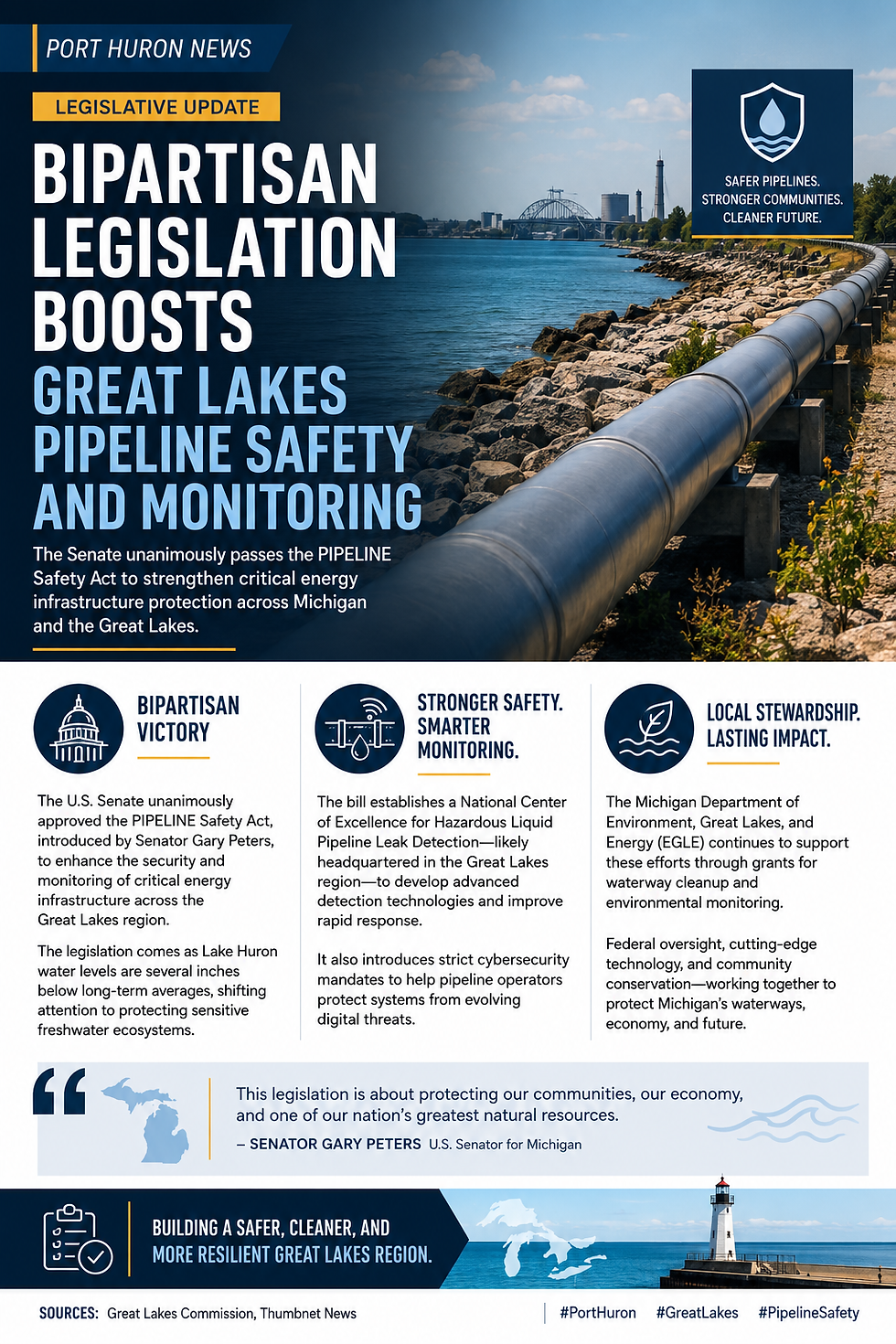
PORT HURON, MI — The United States Senate has unanimously approved the PIPELINE Safety Act, a bipartisan measure introduced by Michigan Senator [Gary Peters] aimed at significantly strengthening the security and monitoring of critical energy infrastructure across the Great Lakes region.
The legislation arrives as Port Huron and surrounding coastal communities continue navigating shifts in Lake Huron’s hydrologic cycle, with water levels currently measuring several inches below long-term averages. While the lower lake levels have temporarily reduced the severe shoreline erosion seen in recent years, they have also intensified concerns surrounding the protection of sensitive freshwater ecosystems from potential industrial accidents.
A major component of the legislation is the creation of a National Center of Excellence for Hazardous Liquid Pipeline Leak Detection, which could ultimately be headquartered within the Great Lakes region to take advantage of local academic and technical expertise.
Officials say the center will focus on developing advanced leak-detection technologies and improving rapid-response capabilities for the more than 100,000 miles of pipeline infrastructure operating throughout Michigan.
The bill also introduces stricter cybersecurity requirements, mandating that pipeline operators strengthen digital protections against emerging cyber threats similar to the recent attacks targeting regional energy and educational systems.
Local environmental stewardship efforts remain a key priority as the federal safety measures move forward. The Michigan Department of Environment, Great Lakes, and Energy continues supporting waterway cleanup and environmental monitoring projects through targeted grants and restoration initiatives.
By combining increased federal oversight with grassroots conservation efforts, officials hope to better protect the Blue Water Area’s environmental health and economic stability during a period of fluctuating water levels and evolving infrastructure challenges.
Sources: peters.senate.gov, congress.gov,


Comments